Hiring a Water Damage Contractor in NYC
The warning signs, the licenses to check, and the four documents to ask for before anyone opens a wall in your apartment
Hiring a water damage contractor in New York goes wrong in the same handful of ways, and every one of them can be caught in the first conversation. Most people hire under pressure, in a hallway, with water still coming through a ceiling, and the contractor who turned up first gets the job on the strength of a van and a clipboard. What follows is a list of the things worth checking before the equipment is plugged in, written for a tenant, a shareholder, a condo owner or a row-house owner who has never had to do this before.
New York has more rules about this work than most cities, and they are useful to you. The city licenses home improvement contractors, the state licenses mold work and separates the company that assesses from the company that remediates, plumbing repairs have to be done by a Licensed Master Plumber, and boards and managing agents have paperwork requirements of their own. A contractor who knows those rules will have the answers ready; one who does not will get vague.
Twelve Warning Signs
No DCWP Home Improvement Contractor license, or one they cannot show
Any contractor doing repair or remodeling work on a one- or two-family home in New York City has to hold a Home Improvement Contractor license from the Department of Consumer and Worker Protection, and the number belongs on their contract and their advertising. Ask for the number and look it up on the DCWP license search at nyc.gov before signing. A contractor who says the license is "in the office" or "being renewed" has told you what you need to know.
Mold work offered by someone without a New York State mold license
Since 2016, New York State Labor Law Article 32 has required a Department of Labor license for any mold assessment or remediation covering more than ten square feet. The license types are Mold Assessor, Mold Remediation Contractor and Mold Abatement Worker. The state publishes the list of licensees on data.ny.gov; search for "mold" and the company name. A water damage contractor who offers to "take care of the mold while we are here" on a wall-sized patch, with no license and no assessor, is offering to break the law in your apartment.
The same company assessing the mold and removing it
Section 936 of Article 32 says that no licensee may perform both mold assessment and mold remediation on the same property, and nobody may hold an interest in both companies. The sequence the law expects is an independent licensed assessor who writes a remediation plan, a separate licensed contractor who carries it out, and the assessor back afterward for a clearance. A contractor who says they will assess it, remediate it and clear it themselves is describing exactly the arrangement the statute forbids.
An assignment of benefits in the paperwork
An assignment of benefits transfers your insurance claim to the contractor, who then bills and argues with your carrier directly and can pursue you for anything the carrier declines. Read every page before signing, and look for the words "assign", "assignment" or "direct payment". Direct billing to your insurer is a service; assigning them your claim is a decision, and one you can decline. Ask instead for the contractor to invoice you and to supply the scope, photographs and moisture log your carrier needs.
No certificate of insurance, or one your board rejects
Co-op and condo boards, managing agents and doorman buildings will not let equipment through the lobby without a certificate of insurance naming the building, and they are right to ask. A contractor who cannot produce a current certificate showing general liability and workers' compensation within the hour either does not have the cover or has never worked in a managed building. Either way, the job is going to stall at the front desk.
No written scope before the demolition starts
The most common complaint about restoration companies nationally, in published review data on the largest brands, is an invoice far above anything discussed, because nothing was written down before the walls came out. Insist on a written scope that lists what will be removed, what will be dried in place, what equipment will be used and for how many days, and what the estimate rests on. If a contractor wants to "get started and sort out the paperwork later", the paperwork will be the invoice.
No moisture readings, or readings you are never shown
Drying is proved by numbers. A contractor working to the IICRC S500 standard takes moisture readings on the day of arrival, sets a dry standard from an unaffected part of the same material, and records readings daily until the wet material reaches it. Ask to see the log. A contractor who cannot show one has no basis for how many equipment days you are being billed, and no basis for saying the plaster is dry before it gets skimmed and painted.
Equipment left running with nobody checking it
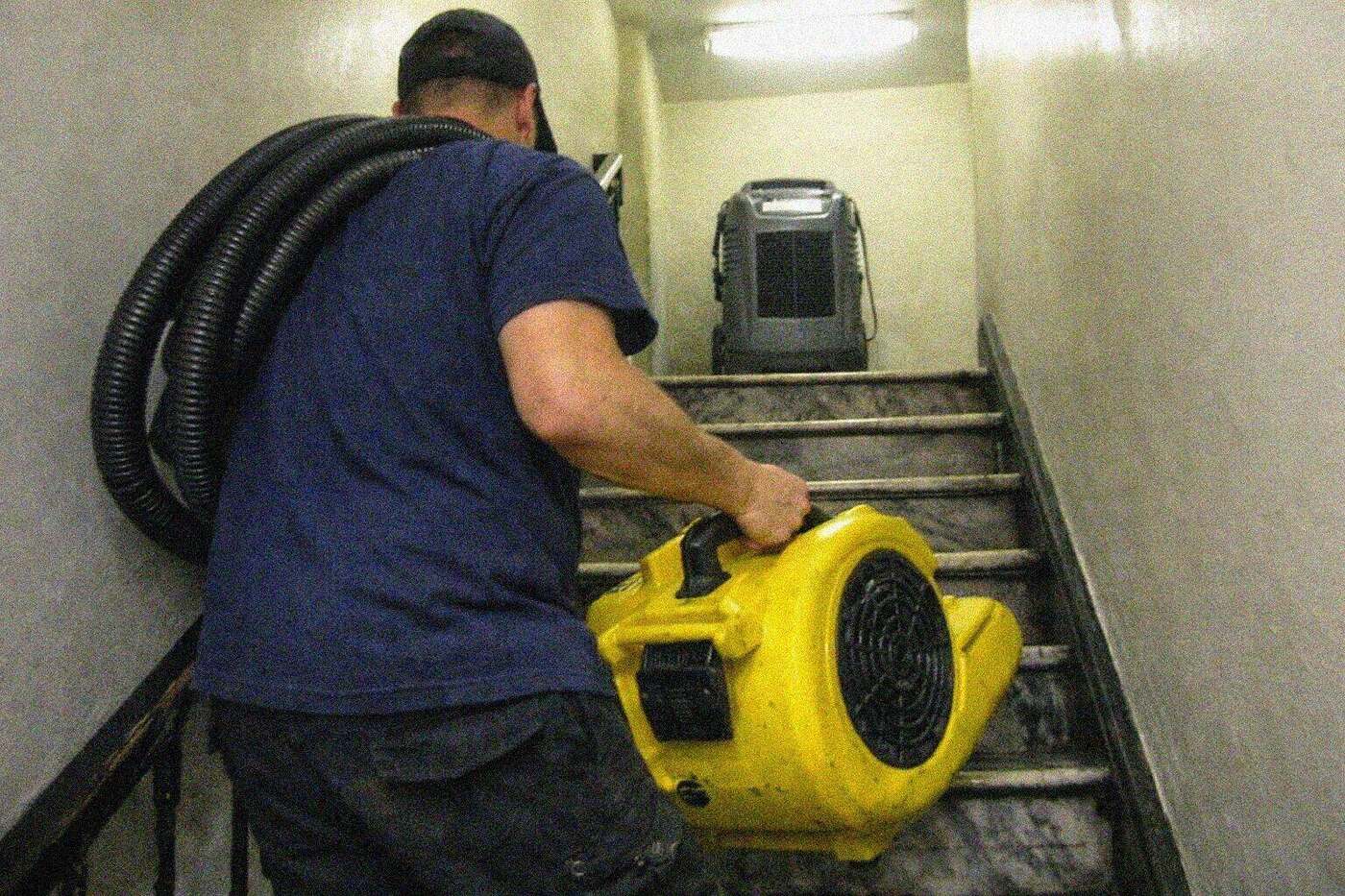
Air movers and dehumidifiers are billed by the day, and a common padding of the invoice is to leave them running past the point the readings hit target, or to drop them in a room and not come back. Daily visits are the norm on a properly run job, and the readings from each visit are what decide when the equipment comes out. If a week passes with fans humming and no one at the door, call and ask for the log.
The price changes once the walls are open
Scopes do change when a wall reveals more than expected, and a good contractor tells you in writing before doing the extra work. A price that keeps rising with no written change order, or an invoice at the end with items you never agreed to, is the pattern behind most of the disputes in this trade. Ask on day one how changes to the scope will be handled and whether you will be asked to sign off on each one.
A promise to waive or absorb your deductible
"We will cover your deductible" means the deductible is being added back into the claim somewhere else, which is insurance fraud in New York and puts your own claim at risk if the carrier finds it. The same goes for an offer to inflate the scope to make room for the deductible. A contractor who opens with this is telling you how they handle the rest of the paperwork.
Pressure to sign in the hallway
Water damage contractors know that a person standing under a dripping ceiling will sign almost anything, and some arrive with the contract already on the clipboard. The urgent part of the job, closing the valve and getting the water out, can be done on a short written authorization for the emergency work only. The full scope, the estimate and anything touching your insurance claim can wait an hour while you read them. A contractor who will not start the extraction without the full contract signed is not the one to hire.
No Licensed Master Plumber for the plumbing half
Restoration contractors dry and repair what got wet; they do not repair the pipe that caused it, and in New York City that work has to be done by a Licensed Master Plumber. A burst riser, a failed radiator valve, a backwater valve on the house sewer and a house connection repair all fall under that rule, and DEP will only accept a sewer repair filed by an LMP. Ask who is doing the plumbing and check the name on the Department of Buildings license search. A contractor who says their own crew will "swap the pipe" is doing unlicensed plumbing in your building.
How to Check a Contractor's Licenses in Five Steps
- Ask for the DCWP license number and search it Get the Home Improvement Contractor license number from the contractor, then look it up on the Department of Consumer and Worker Protection license search at nyc.gov. Confirm the business name matches the one on the contract, the license is current, and there are no unresolved complaints listed against it.
- Search the state mold license list on data.ny.gov Open data.ny.gov, search for the Department of Labor's mold license dataset, and look up both the remediation contractor and the assessor by company name. Confirm each holds the right license type and that they are separate companies with no shared ownership.
- Look up the plumber on the Department of Buildings license search Whoever is doing the plumbing repair should be a NYC Licensed Master Plumber. The Department of Buildings publishes a license search; enter the plumber's name or license number and confirm the license is active.
- Check EPA Lead-Safe certification for pre-1978 buildings If the building was built before 1978, which covers 54 percent of New York housing per the 2023 Housing and Vacancy Survey, the contractor disturbing painted plaster or trim should be an EPA Lead-Safe Certified Firm. The EPA keeps a public search of certified firms on its website.
- Get the certificate of insurance and send it to the building Ask for a current certificate showing general liability and workers' compensation, with your building named as certificate holder, and send it to the managing agent or board before equipment arrives. Call the insurer named on the certificate if anything about it looks stale.
Four Documents to Ask For
- A written scope and estimate. It lists what will be removed, what will be dried in place, the equipment and the number of days it is based on, and the price. It is the reference point for every later conversation about cost, and without it the invoice is the first number you see.
- The moisture log. Daily readings, photographed, against a dry standard taken from unaffected material. It proves the drying finished and justifies every equipment day on the invoice.
- The contents inventory. A photographed list of everything packed out, signed by you before it leaves, with the storage address and the monthly cost stated. Missing belongings after a pack-out are among the most common complaints in this trade, and the inventory is your only record.
- The mitigation-to-reconstruction handoff in writing. A statement of where the drying job ends, where the rebuild begins, who is doing each part, and the expected start date of the reconstruction. Jobs that stall for months between the two stages are the most consistent complaint about restoration companies nationally, and a written handoff is what prevents it.
Eight Questions to Ask Before You Sign
- What is your DCWP Home Improvement Contractor license number, and who holds the New York State mold license if mold is found?
- Who is the licensed Mold Assessor, and are they a separate company from you?
- Which Licensed Master Plumber will repair the pipe, and when?
- Can you send a certificate of insurance naming my building to the managing agent today?
- Will I get a written scope and estimate before any wall is opened, and how will changes to it be handled?
- How often will someone visit while the equipment is running, and will I see the moisture readings?
- Are you asking me to sign an assignment of benefits, and can I decline it and pay by invoice instead?
- Where does your mitigation work end, who is doing the reconstruction, and when is it expected to start?
If There Is Water in the Apartment Right Now
The checklist is for the person deciding who to hire. If the water is still coming in, the order is different: find the shutoff or get the super to close the riser, cut power to any area where water is near outlets or fixtures, photograph everything before it is moved, and then call. The water damage restoration page sets out what happens from there.
Questions About Your Own Situation?
The checklist covers the general case. For the apartment in front of you, a call is quicker.
The phone is picked up 24 hours a day, seven days a week, on every holiday in the year.