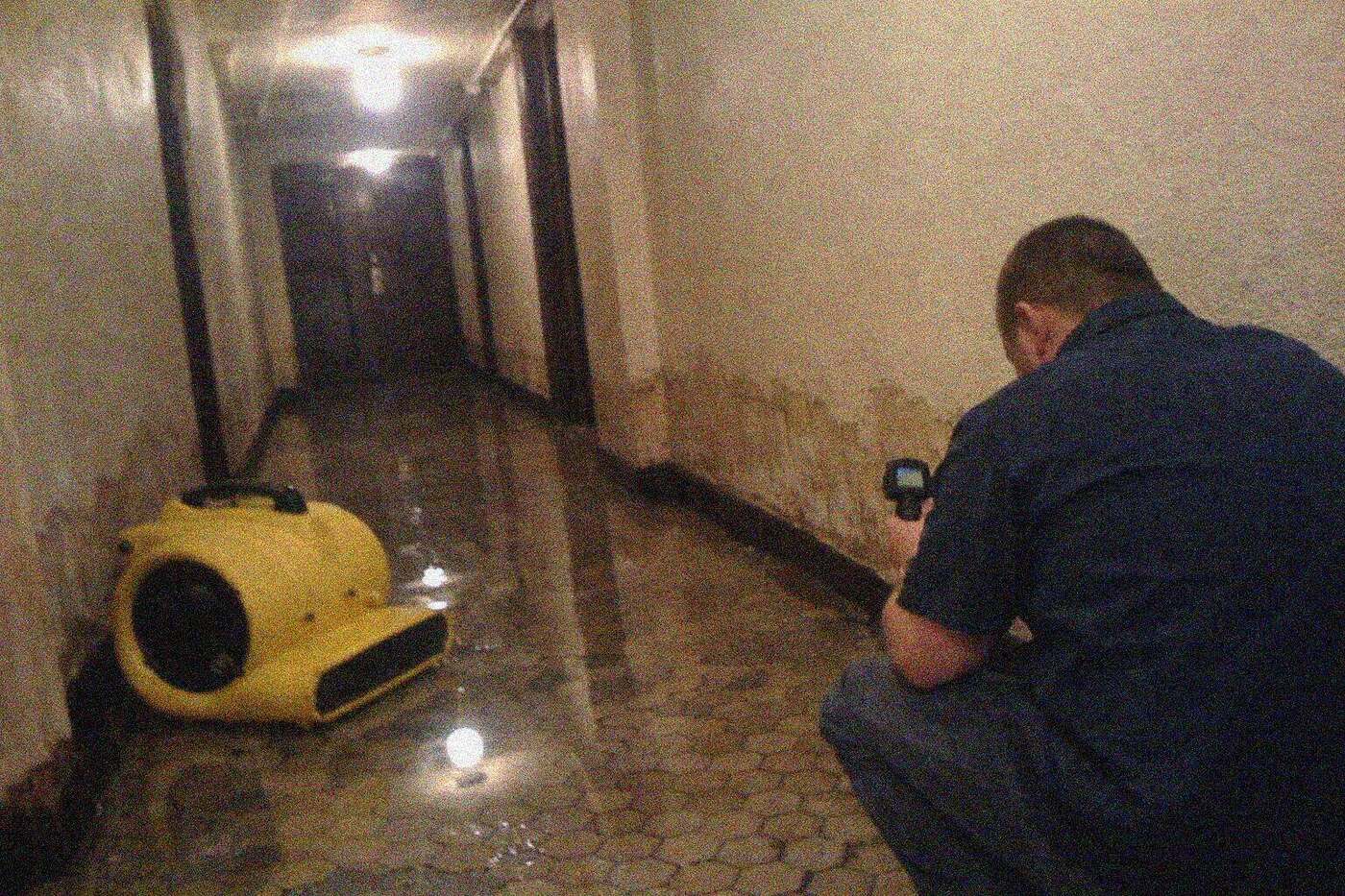
Water Damage Restoration in New York City
From the first extraction pass to the last coat of paint, in pre-war walk-ups, doorman towers and row houses across the five boroughs.
Water damage restoration in New York City means finding where the water came from in a building full of other people's plumbing, stopping it, pulling out what is standing, drying plaster and old-growth joists against a measured standard, removing what will not dry, and then putting the apartment back together in a way the board, the landlord and the insurer will each sign off on. Most calls come from a unit where the water started somewhere else, so the job includes working out who is responsible and getting equipment past a doorman.
Below is how a job runs here: what the first hours should look like, how the water is categorized and what that decides, what the vertical stack does to a leak, who pays under a lease, a proprietary lease or a condo declaration, what happens to plaster and parquet, what the building will ask for before anyone plugs in a dehumidifier, and what drives the price. If your floor is wet now, the phone is quicker than reading, and a person picks it up at any hour.
What Does Water Damage Mitigation Cost in New York?
Published national figures put mitigation at 3.75 to 7.50 dollars per square foot depending on the water category and the materials, and New York labor sits above that national median. Nobody in this trade publishes a city rate, so the estimator below applies the national model to your rooms and states plainly that it covers drying and removal only. Rebuilding is priced separately once the scope is known.
The First Hours in a New York Apartment
The first job is to find the shutoff, and in a New York building that is often somebody else's. A single apartment usually has stop valves under the sink and behind the toilet, but a riser break or a leak from above is shut at the branch or the main, which means the super, the resident manager or the building's plumber. Call them first, then call for the drying. If the super cannot be raised and water is coming through a light fixture, kill the circuit at the breaker before anything else.
Photograph everything before it is touched: the ceiling, the floor, the wall where the water is showing, the source if you can see it, and your belongings where they sit. Then start moving what you can. Rugs off the floor, books and electronics up on the table, furniture legs on foil or plastic lids. Bath towels along the base of a wall slow the spread into the next room. Leave the plaster alone; a bulging ceiling is holding water, and it should be opened on purpose with a bucket underneath by whoever attends, because a plaster-on-lath ceiling that lets go on its own brings down far more than a drywall one.
Do not run a box fan across the room. On clean water it does little, and on anything that has come through a wall cavity or up a drain it pushes contamination into the air. Do not stack wet carpet in the hallway, where it wets the neighbor's threshold and the building's floor. Do not throw anything out before it has been photographed, because an insurer can only pay for what was recorded. And phone the neighbor below you. Water that is on your floor now is on their ceiling in an hour, and a warning before the drip starts is the difference between a friendly conversation and a claim.
Category 1, 2 and 3: What the Water Carries Decides What Gets Removed
The IICRC S500 standard sorts water into three categories by contamination, and the category sets the scope before anyone measures a thing. A Category 1 loss from a clean supply line can mostly be dried in place. A Category 3 loss from a sewer surcharge or floodwater off the street means every porous material the water touched is cut out, bagged and taken down the freight elevator. In a New York building the category also changes as the water travels: clean water from a burst riser on the tenth floor picks up decades of dust, old insulation and whatever was in the ceiling cavities on its way down, and arrives on the sixth floor as something dirtier than it left.
Video: the IICRC, the body that publishes the S500 standard, on the WRT certification.
| Category | What it is | Where it comes from here | What happens to plaster, wood and fabric |
|---|---|---|---|
| Category 1 | Clean water from a sanitary source | Burst supply riser, failed radiator valve, overflowing tub with no soap, split washer hose | Dried in place where reached in the first day or two; carpet pad and swollen particleboard may still go |
| Category 2 | Significantly contaminated, sometimes called gray water | Dishwasher or washing machine discharge, toilet overflow with no solids, Con Edison steam condensate through old pipe lagging | Carpet pad, insulation and wet contents removed; plaster and wood usually dried; hard surfaces cleaned |
| Category 3 | Grossly contaminated, sometimes called black water | Combined sewer backup through a cellar drain, floodwater from the street or the harbor, toilet overflow past the trap | Everything porous removed to the wettest point plus a margin: carpet, pad, drywall, plaster on lath, insulation, particleboard cabinets |
Time moves water down the table. Category 1 water left in a warm plaster wall for four or five days is treated as Category 2, since bacteria have had days to work on it inside a dark cavity, and a leak discovered on a return from vacation is scoped harder than the same leak caught the same evening. The second scale, Class 1 to 4, measures how much material is wet and how hard it is to dry. Plaster, terracotta block, hardwood and concrete are all low-permeance materials, which puts most pre-war New York losses at Class 3 or 4. That is the reason a loss in a plaster apartment and one of identical size in a drywall extension can be several times apart in both price and equipment days.
The Vertical Problem: One Leak, Several Apartments
In a multi-unit building the leak you can see is one floor of a stack that runs from the roof tank to the cellar.
Apartment lines in a New York building sit one above another, sharing a riser for supply and a stack for waste, so water from one unit follows the pipe chase and the joist bays straight down. A bathtub left running on the eleventh floor produces a wet ceiling on ten, a stained wall on nine, and a damp closet on eight that nobody notices for a month. According to the 2023 NYC Housing and Vacancy Survey, 62 percent of the city's units are in buildings of six or more apartments and over half are in buildings of twenty or more, which is why the downstairs neighbor is often the person who makes the call.
Drying one apartment in a stack means checking the ones around it. Whoever attends the property meters the ceiling below and the shared wall on either side, because water that has left the source unit is still in the building, and a dry reading in the wet apartment means little if the joist bay under it is saturated. That is where the super and the managing agent come in, since getting into a neighbor's apartment to take readings or set a dehumidifier is an access negotiation before it is a technical step.
Con Edison steam adds a Manhattan-only version of the same problem. The district system runs from the southern tip of the island to 96th Street, and a building-side steam leak or a blown radiator trap releases hot condensate that travels through floors faster than cold water and cooks old paint and lagging on the way. Steam losses are treated as Category 2 at minimum, and any pre-1980 pipe insulation the water passed through is left for an asbestos survey before it is disturbed.
Co-op, Condo or Rental: Who Pays for the Repair
Responsibility follows the paperwork you hold on the apartment, and the same leak is handled three different ways depending on whether it is a lease, a proprietary lease or a condo declaration.
In a rental the landlord owes the warranty of habitability under New York law and has to keep the apartment in the condition the Housing Maintenance Code requires, which includes fixing the leak and repairing the ceiling it came through. The route is the super first, then a written complaint to management, then 311, which opens an HPD complaint that a Code Enforcement inspector can act on if nothing happens. A tenant's own belongings are a separate matter; those are what an HO-4 renters policy exists for, and the landlord's insurer will usually point you there.
In a co-op the corporation is the landlord in law and the shareholder holds a proprietary lease. Paragraph 18 of the standard form, which most New York co-ops use with variations, makes everything inside the apartment's walls the shareholder's responsibility and the pipes, risers and structure the building's. In practice the building repairs the pipe and the structure first, because the warranty of habitability applies to it as a landlord, and then pursues a negligent shareholder for what it spent. Court decisions have held that a shareholder with a recurring leak cannot withhold maintenance over it, so the pressure has to be applied through the board and, if needed, a lawyer.
In a condo the declaration and bylaws define the unit and the common elements, and the line is often drawn at the midpoint of the wall or the unfinished surface of the slab. The owner pays inside the unit; the board pays for common elements; and a leak from one unit into another is usually an owner-to-owner matter with the board's master policy sitting behind the common areas. Read the declaration before agreeing to anything, because the definition of the unit varies from building to building.
Insurance runs the same way in all three: the building carries a master policy for the structure and common elements, and residents are told to file first on their own HO-6 or HO-4 policy and let the carriers subrogate against whoever is at fault. Direct billing in New York therefore means billing either the resident's carrier or the building's, and the scope has to say which one before the work starts. The carrier decides what the policy pays, and it decides on the moisture log, the photographs and the written scope.
What Gets Dried and What Comes Out in a Pre-War Building
Plaster on wood or metal lath is the defining material of the New York apartment, and it behaves unlike drywall in water. It absorbs slowly, holds water for a long time, and dries slowly, so a plaster wall that reads wet on day one may still be reading wet on day eight while the drywall in the newer kitchen extension has been dry since day three. Sound plaster on a Category 1 loss is dried in place with air movers and dehumidification. Plaster that has lost its key to the lath, which shows as a hollow sound and a bulge, comes down, because it will fall on its own eventually.
Terracotta block partitions, common in early twentieth-century apartment houses and loft buildings, soak up water like a sponge and give it back over weeks. They are dried with directed air and low-grain dehumidifiers and take longer than almost any other wall. Concrete-slab high-rises have the opposite problem: there is no cavity to dry into, so water sits under the flooring and in the leveling compound, and the floor covering usually has to come up to get at it.
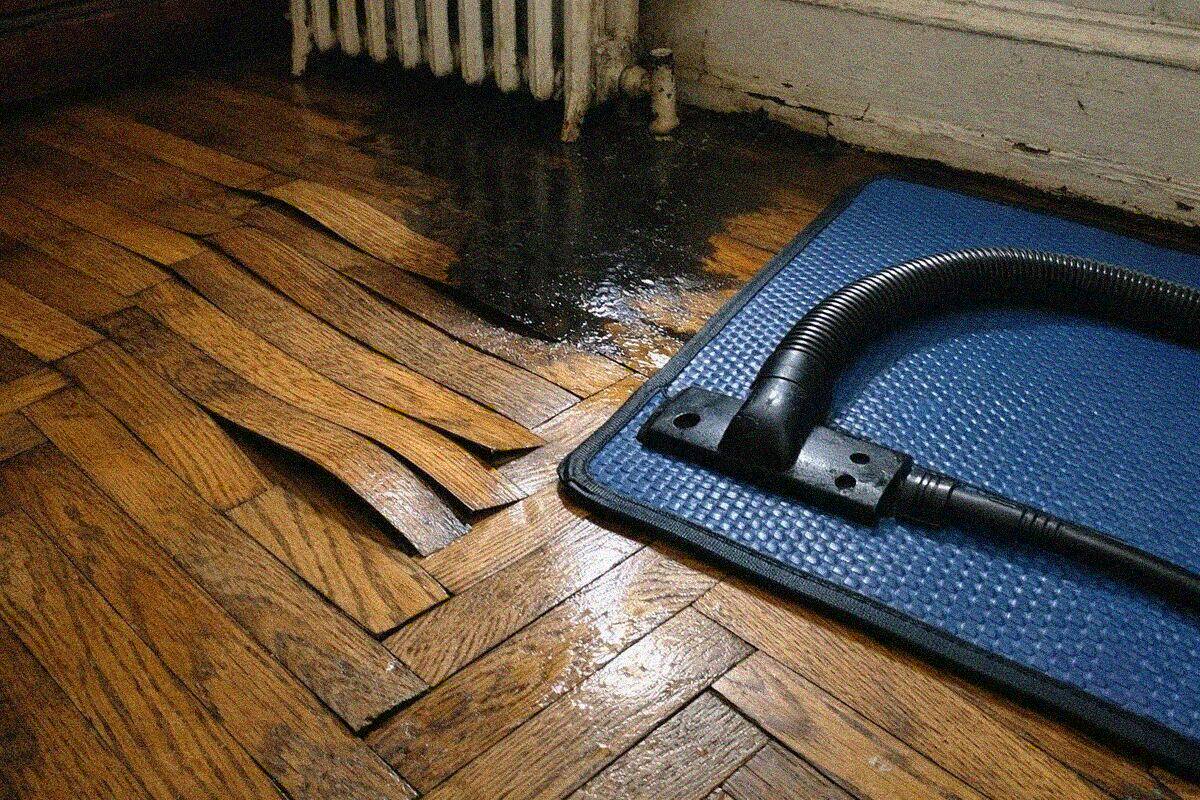
Flooring is where the money decision sits. Pre-war quartersawn oak parquet and herringbone can often be brought back flat with drying mats that pull moisture up through the boards, provided the work starts before the cupping sets. Refinishing a dried parquet floor runs a fraction of what replacing a matching pre-war pattern costs, and the pattern is rarely available off the shelf, so the first day or two decide whether the floor is saved. Carpet pad, particleboard cabinet bases, MDF trim and any insulation that got wet are removed on nearly every job, whatever the category.
Anything painted before 1978 is assumed to carry lead paint until tested, and 54 percent of New York housing predates 1947 per the 2023 Housing and Vacancy Survey, so opening a pre-war wall is done under EPA Renovation, Repair and Painting rules by a Lead-Safe Certified firm, with containment and HEPA cleanup. That adds a day and some cost, and it is the law.
Getting Equipment Into the Building
A doorman building will want three documents before a single air mover crosses the lobby, and the freight elevator schedule sets the pace of the whole job.
Co-op and condo boards, managing agents and tower management routinely require a certificate of insurance naming the building and its agent as additional insured, an equipment list with the amperage of every machine, and a written access plan before anything comes in. The contractors we dispatch carry these as standard, and sending them to the managing agent on the first call saves a day. Where a building has an alteration agreement, drying is usually treated as emergency work outside it, but reconstruction will fall inside it and needs the board's sign-off.
Then there is the physical route. Freight elevators in Manhattan run to set hours, often eight to four on weekdays with nothing on weekends, and equipment that arrives at five in the evening waits in the van until morning unless the super makes an exception. Walk-ups mean every extractor, air mover and dehumidifier goes up the stairs by hand, and a fifth-floor unit in a Bronx or Brooklyn walk-up is set with lighter equipment for that reason. Alternate-side parking rules decide where the van can sit, and a truck-mounted extractor on the street with a hose up four floors is a rare sight for good reason.
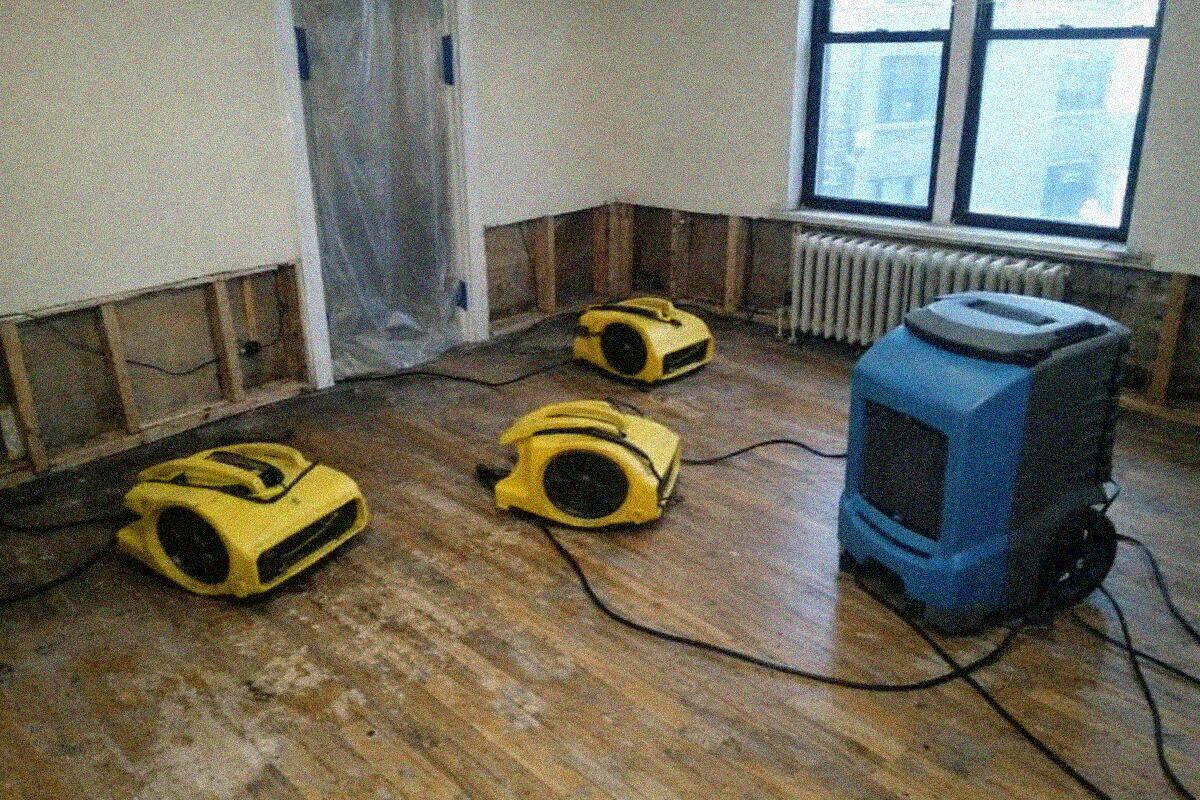
Power is the last constraint. A pre-war apartment on a 60-amp service with two-prong outlets will not run four air movers and a dehumidifier on one circuit, so the equipment plan includes which circuits carry what, and sometimes a request to the super for a hallway or basement feed. Daily readings and equipment checks mean daily access, which means the super or the resident is available each day at an agreed time.
What Drives the Cost of Water Damage Restoration in NYC
Published 2026 national cost surveys from Angi and HomeGuide put mitigation between 3.75 and 7.50 dollars a square foot, and a New York job sits at or above the top of that range.
The per-square-foot figure is for mitigation: extraction, demolition of what cannot be dried, equipment, daily monitoring and antimicrobial treatment. It moves with the water category, so a clean-water loss on a tile floor is at the bottom and a sewage backup across a finished cellar is above the top, because removal and disposal of contaminated material costs more than drying it. Reconstruction is a second, separate bill and on any job where walls or floors came out it is commonly the larger of the two.
New York pushes each driver upward. Labor and insurance cost more here than in most of the country. Pre-war plaster and parquet are Class 3 or 4 materials that take longer to dry, and equipment bills by the day. Building logistics add time: a COI, a freight elevator window and a walk-up carry all cost hours. Lead-safe work practices on pre-1978 paint add a day of containment. Contents that have to leave the apartment add packing, transport and storage, and StorageCafe put the average 10 by 10 self-storage unit in the city at 271 dollars a month in August 2026, ranging from 119 dollars in Hunts Point to 546 in Yorkville.
Time wet is the driver you control. A loss dried from the first day stays a Category 1 drying job; the same loss found on the fourth day has moved into removal, may have moved into mold, and can double in price. The estimator above gives a mitigation range from square footage, category, time wet and flooring, and it says on the result that it is an estimate. A firm figure comes only after the meters have been through the walls and the scope is on paper.
- Water category: clean, gray or black, which sets how much is removed instead of dried
- Square footage of wet floor and wall, measured with meters rather than by eye
- Time wet before drying started, with anything past a day treated more aggressively
- Materials: plaster on lath, terracotta block, parquet and concrete slab all take longer than drywall and carpet
- Building access: freight elevator hours, walk-up floors, COI processing and parking
- Lead-safe containment on pre-1978 paint and any asbestos survey on old pipe lagging
- Contents pack-out, transport and off-site storage for the length of the job
- Whether the neighboring units also need drying, and who is paying for that
Where Drying Ends and Rebuilding Begins
The handoff from mitigation to reconstruction is named in writing before the last dehumidifier leaves, with a date and a name attached to each side of it.
Mitigation is finished when every marked point reads at or below the dry standard taken from an unaffected area of the same material, and the log shows it. At that point the equipment comes out, the invoice for mitigation is closed, and the apartment is an empty shell with flood cuts in the walls, no baseboard and a floor that is either saved or gone. Nothing about that state says who rebuilds it or when, and in the national review corpora that gap is the single most repeated complaint in the trade: dried in a week, then an apartment left open for months.
The written handoff fixes it. Before mitigation closes, the scope names the reconstruction contractor, lists what the rebuild covers, states the date it starts, and says whether the same company or a different one is doing it. In a co-op or condo that document is also what goes to the board with the alteration agreement, because reconstruction falls inside it even where emergency drying did not. Where the rebuild involves plumbing, a NYC Licensed Master Plumber files and does that part, and on a one-to-two-family house the reconstruction contractor holds a NYC DCWP Home Improvement Contractor license, which you can check by number before signing.
The rebuild itself in a pre-war apartment is plaster patching to match the existing surface, a skim coat over the flood-cut line, primer and two coats, baseboard and shoe molding profiled to the original, and parquet either refinished or replaced in matching pattern. The last thing that happens is a walkthrough with the moisture log, the photographs, the inventory of anything that was packed out, and the board's sign-off, all in one folder that the insurer and the managing agent both get.
Signs of Water Damage in a New York Apartment
Most of the water in a New York building is behind plaster, so the first signs are on the surface and the source is somewhere else.
A brown ring around a ceiling fixture
Water has pooled on the lath above and soaked through at the lowest point, which is usually the hole cut for the light. A hard edge means it has wet and dried more than once, so the source is intermittent, and the apartment above or the riser in that chase is the first place to look.
A bulge or sag in a plaster ceiling
The plaster has lost its key to the lath and is holding water in the belly. That ceiling is coming down; the question is whether it is opened on purpose with a bucket underneath or on its own at three in the morning. Keep out from under it and call.
Parquet lifting at the edges
Cupped boards mean the wood is wetter underneath than on top, and the water is often from the unit below or from a slab, so it can appear rooms away from any leak you can see. The cupping is recoverable early and permanent once the boards crown.
Paint blistering low on a wall or around a radiator
Water is wicking up from the floor or leaking from the heating riser behind the wall. In steam-heated buildings a failed radiator valve or a leaking return line under the floor shows here first.
A musty smell in a closet on a shared wall
Closets sit on the pipe chases, and a smell with no visible stain means the wall cavity has been wet long enough for growth to start. The US EPA puts the window before growth begins at 24 to 48 hours, and a closet smell usually means the leak is older than that.
The super has been in the apartment upstairs
A plumber's visit to the unit above, a stack of towels in the hallway, or a neighbor asking if you have a leak are all earlier warnings than anything on your own ceiling. Water that has been stopped upstairs is still in the floor between you.
How a Water Damage Restoration Call Runs in New York
Call, and describe the building
A person answers at any hour and asks what is wet, where the water is coming from, what kind of building it is and who manages it. That determines who is contacted about the shutoff and what the access plan needs to include.
Source stopped and the building notified
The super, the managing agent or a Licensed Master Plumber shuts the source, and the certificate of insurance, equipment list and access plan go to management so the freight elevator is available when the equipment arrives.
Inspection, moisture mapping and a written scope
Whoever attends meters every wall, ceiling and floor in the apartment and the neighboring units where they can get in, records the readings, photographs everything, and writes a scope with a price before any plaster is opened.
Extraction, removal and drying
Standing water is extracted, materials that cannot be dried are cut out to a marked line, contents are inventoried and moved or packed out, and air movers and dehumidifiers are set to the room and the class of loss. Readings are taken daily at the marked points and logged.
Dry standard reached, then the written handoff
Equipment comes out when the log shows the dry standard, and the scope for reconstruction, with a start date and a named contractor, is agreed before it does. The final folder holds the log, the photographs, the inventory and the board paperwork.
Tell Us What Is Wet and Where
The building type, the floor, where the water is coming from and whether it has reached the unit below. A person reads it and calls you back.
The phone is picked up 24 hours a day, seven days a week, on every holiday in the year.
Why New Yorkers Call This Number
A scope with a price before any plaster is opened
The wet area is mapped with meters and the plan is on paper, price attached, before demolition starts. Changes need your written sign-off, and the same document goes to the board, the landlord and the carrier.
Licensed under NYS Labor Law Article 32 and NYC DCWP rules
The contractors we dispatch hold a NYS Mold Remediation Contractor license, work alongside an independent licensed Mold Assessor on any mold over ten square feet, hold a NYC DCWP Home Improvement Contractor license for one-to-two-family homes, and are EPA Lead-Safe Certified for pre-1978 paint. Each is listed on a public lookup, and you should check it.
Daily readings logged against a dry standard
Moisture is read at the same marked points every day and written down against a standard taken from an unaffected area of the same material. On a clean-water loss caught early the IICRC S500 standard puts that at three to five days, and the log is how you know the equipment came out on time.
A typical water damage restoration call in Washington Heights
The situation: A shareholder in a 1920s six-story elevator building on the west side of Washington Heights comes home on a Sunday evening to water dripping from the kitchen ceiling fixture and a bulge in the plaster over the counter. The apartment above is empty; its owner is away. The super shuts the branch valve to the line and the water slows to a drip.
What gets done: The call comes in that night, and the managing agent has a certificate of insurance and an equipment list in the inbox before the doorman's shift changes. Whoever attends meters the kitchen ceiling, the shared wall into the bedroom and the ceiling of the apartment below, opens the bulge over a bucket, finds a corroded galvanized supply riser weeping in the chase, and writes a scope for a Category 1 loss on plaster and lath with the lower unit included. A Licensed Master Plumber replaces the riser section the next morning. Air movers and a dehumidifier run in both apartments, and readings are logged daily.
The result: The plaster reads at the dry standard on day six, the equipment comes out, and the handoff names the reconstruction contractor and a start date for patching, skim coat and paint. The board's records show the riser as building responsibility, the corporation's carrier and the shareholder's HO-6 carrier sort out the split, and the moisture log and photographs go into both files.
Before you let anyone open a wall
A short checklist for hiring a water damage contractor in New York City: the licenses to look up, the warning signs, and the four documents to ask for on any job.
Questions New Yorkers Ask
How quickly can someone be at my apartment?
The phone is answered around the clock, every day of the year, and the response starts on that call. How long the drive takes depends on the borough, the hour and the building's own access rules, and you get a straight answer about timing while you are on the line. Until then, shut what you can, cut power to the wet room and photograph everything.
The water came from my upstairs neighbor. Do I pay for my own ceiling?
Usually not out of your own pocket in the end, though you may pay first. A tenant looks to the landlord, who owes the warranty of habitability and has to repair the ceiling. A co-op shareholder looks to the corporation, which repairs the structure and typically recovers from the neighbor afterwards. A condo owner reads the declaration and files on the HO-6 policy, whose carrier subrogates against the neighbor's. In every case, file on your own policy first and keep the photographs and the moisture log.
Can the drying start before the co-op board approves anything?
In most buildings, yes. Emergency drying is treated as mitigation outside the alteration agreement, and management needs only the certificate of insurance, the equipment list and the access plan to let the equipment in. Reconstruction is different: patching, painting and flooring in a co-op or condo usually fall inside the alteration agreement and need the board's sign-off, which is why the handoff paperwork goes to the board early.
Will my pre-war parquet have to be replaced?
Often it can be saved if drying starts in the first day or two. Drying mats pull moisture up through quartersawn oak and herringbone before the boards cup past recovery, and a floor brought back flat can be sanded and refinished for a fraction of the cost of matching a pre-war pattern. Boards that have crowned, delaminated or lifted from the subfloor come out, and the meter readings on days one and two decide which way it goes.
How much does water damage restoration cost in New York City?
Published 2026 national surveys from Angi and HomeGuide put mitigation at 3.75 to 7.50 dollars a square foot depending on category and materials, and New York labor, building logistics, plaster and parquet place most jobs at or above the top of that range. Reconstruction is priced separately and is often the larger half. The estimator above gives a mitigation range from your own numbers; a firm figure follows the meter survey and arrives on paper.
What if mold has already started?
Growth found on more than ten square feet becomes a licensed project under New York State Labor Law Article 32. An independent licensed Mold Assessor writes the work plan and does the clearance, and a separately licensed Mold Remediation Contractor does the removal, because section 936 of the law forbids one licensee doing both on the same property. In a rental, a mold condition of 30 square feet or more is an immediately hazardous HPD violation under Local Law 55, which gives the landlord a 24-hour correction window and is worth knowing when you report it.
Water Damage Restoration by Borough
A page for each borough, written around its own building stock, its flood zones and the way water tends to arrive there.
Related Services
Emergency Water Extraction
Standing water pulled out before it drops through the ceiling of the apartment below.
Read more →Ceiling Leak Water Damage
The stain that came from the apartment upstairs, and the plaster ceiling that is starting to sag under it.
Read more →Apartment and Co-op Water Damage
Leaks that cross unit lines, and sorting out who is responsible for what under a proprietary lease or condo bylaws.
Read more →All 14 services are listed on the services page. How the process runs end to end is on the home page, and the about page explains what to expect from whoever attends.