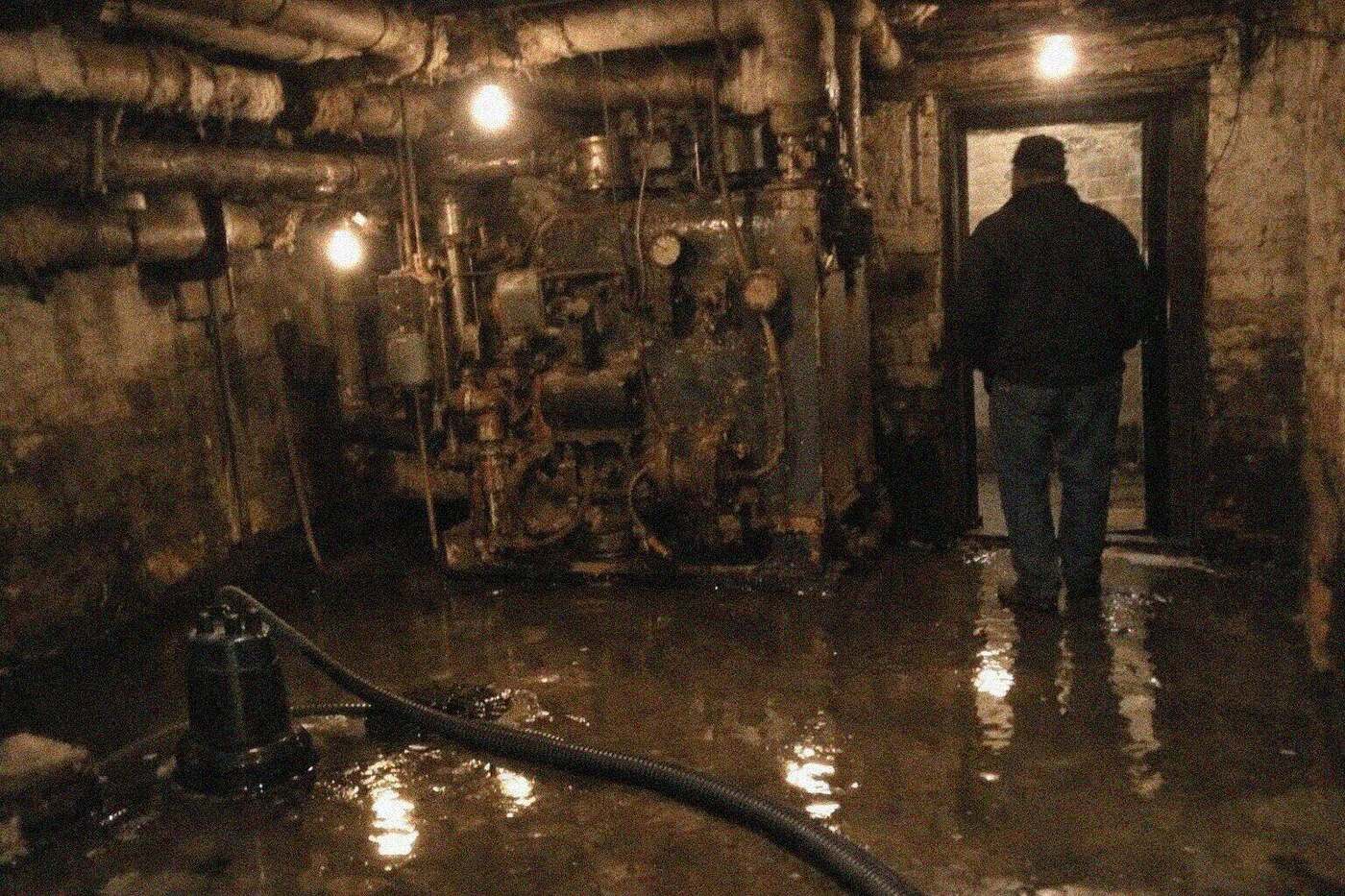
Burst and Frozen Pipe Water Damage in New York City
A split riser behind eighty-year-old plaster, a frozen kitchen line on the outside wall, a radiator valve that let go in January.
Burst and frozen pipe water damage in New York comes mostly out of the age of the buildings: 54 percent of the city's housing was built before 1947, according to the 2023 NYC Housing and Vacancy Survey, and much of it still runs on the galvanized steel and cast-iron risers it was built with. When one of those lines splits inside a plaster wall in a cold snap, the water has usually been running for hours before anyone sees it, and the repair is a two-part job: a NYC Licensed Master Plumber fixes the pipe, and the drying and rebuild follow.
The phone is picked up at any hour, which matters in a freeze because pipes tend to let go overnight and on holiday weekends when the heat has been turned down. Tell whoever answers whether the water is still running and whether the super has been reached, and the plumber and the drying crew get routed at the same time.
Why Pre-War Risers Fail Behind the Plaster
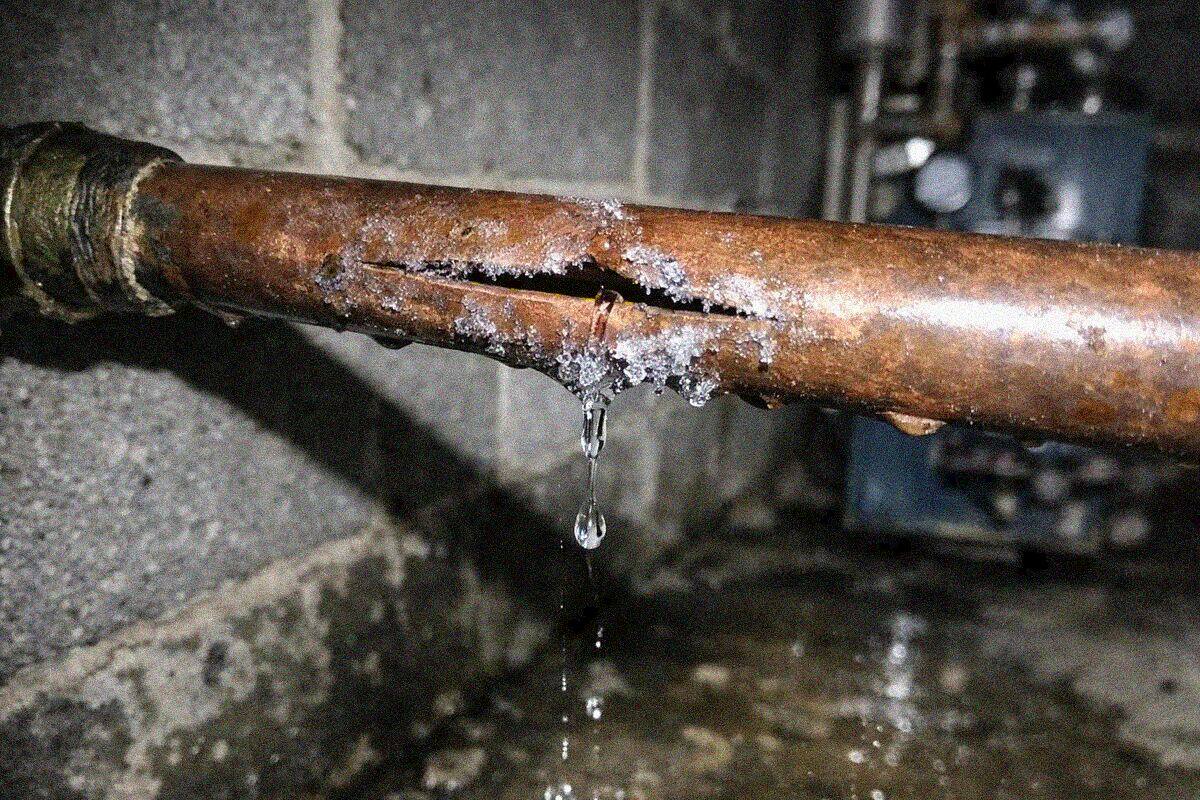
Galvanized steel supply risers corrode from the inside, and after eighty or ninety years the zinc coating is long gone and the threaded joints are the thinnest part of the pipe. Cast-iron waste stacks crack along their length or at the hub. Both kinds of line were built into the wall when the building went up, buried behind plaster on wood or metal lath, and the first sign of trouble is a stain on the wall of the apartment below the failure, sometimes two floors below.
The failure itself is rarely dramatic. A pinhole in a riser can run for weeks inside the wall, feeding a slow bloom of damp plaster that a tenant paints over twice before the super gets involved. A threaded joint that finally lets go in a freeze is different: it dumps the full pressure of the riser into the wall cavity, and a stack of apartments gets wet from that floor down. Either way, the water has been in the wall longer than anyone thinks, which is why a moisture meter goes along the whole riser chase, above and below the visible stain.
Repairing a riser section means opening the wall, and in a pre-war building that means disturbing plaster and paint that predates 1978. The contractors we dispatch are EPA Lead-Safe Certified for that reason, and the wall opening is done with the containment and cleanup the rule requires.
Pipes on Exterior Walls Freeze First
A kitchen sink on an outside wall, a bathroom over an unheated entry, and any line in a cellar next to a broken window are the usual freeze points in a New York apartment.
The NYC Department of Environmental Protection publishes freeze guidance for property owners every winter, and the advice is plain: keep the heat on even in an empty apartment, open the cabinet doors under a sink on an exterior wall so warm air reaches the pipe, let a cold tap trickle on the coldest nights, and know where the shut-off is before you need it. A pipe that freezes does most of its damage when it thaws, because the ice plug that split it gives way and the water starts moving again.
In a row house or a two-family, the vulnerable lines are the ones in the cellar near the front hatch or the rear door, and the hose bib on the back wall that nobody drained in November. In an apartment building the risk is the corner apartments and the top floor, where the roof and two exposed walls pull heat out of the chase. Vacant apartments in a building under renovation are a regular source of freeze bursts, because the heat is off and nobody is inside to notice the first drip.
Never thaw a frozen pipe with an open flame. A hair dryer or a heating pad on the exposed section, working back from the tap, is the safe approach, with the supply valve shut first so that if the pipe has split it does not flood the moment it thaws. If you cannot find the frozen section or the pipe is inside the wall, that is a job for the plumber.
Radiator Valves, Steam Systems and Hot-Water Heat
Most pre-war apartment buildings in New York heat with one-pipe steam. The radiator valve at the base and the air vent on the side are the two parts that fail, and when a valve packing gives out or a vent sticks open, the radiator spits hot water and condensate onto the floor every time the boiler cycles. Over a winter that is enough to rot a section of oak floor and stain the ceiling of the apartment below, and the tenant often has no idea because the leak only runs at night when the heat comes up.
Hot-water heating systems, common in post-war buildings and converted row houses, fail at the pipe joints and the baseboard convector connections, and because the system is under pressure a failure runs continuously until the zone is shut. In Manhattan below 96th Street, Con Edison's district steam system also serves a large number of buildings, and a building-side steam leak brings heat and water together in a way that warps floors and lifts paint faster than a cold-water burst.
Radiator and heating leaks are the building's system in almost every co-op and rental, so the super and management are involved from the start. The drying still has to happen inside your apartment, and the moisture readings on the floor around the radiator and in the ceiling below are what tell the board how far the water traveled.
The Plumber First, Then the Drying
Any plumbing repair on a burst pipe in New York is done by a NYC Licensed Master Plumber, and the drying crew works alongside that repair.
The Department of Buildings requires a Licensed Master Plumber for work on the supply and drainage systems in the city, and on a riser or a main that is the building's job to arrange. What we get moving is the mitigation: the extraction, the wall openings for drying, the equipment and the daily readings. The plumber and the drying crew are on site together on a bad burst, because the wall has to come open for both of them, and it makes sense to open it once.
The split between building and resident follows the pipe. In a co-op, the standard proprietary lease puts the pipes inside the wall and the structure on the corporation and the fixtures, finishes and branch lines inside the apartment on the shareholder. In a rental the landlord owns all of it and owes you a habitable apartment. In a condo the declaration draws the line, often at the wall midpoint or at the point where a branch leaves the common riser. Where your responsibility starts decides who signs the drying scope for which part of the work.
If the pipe that failed was inside your apartment and served only your fixtures, such as a washing machine hose, a dishwasher line or the supply to a bathroom you renovated, the repair and the drying are usually on you and your HO-6 or HO-4 policy, with the building's carrier covering the structure below and subrogating afterwards.
What Comes Out of the Wall and What Stays
Once the plumber has the pipe fixed, the question is how much of the wall and floor around it can be dried in place. Plaster on lath is heavy, dense and slow to dry, and it holds water in the lath behind it long after the surface reads dry to the touch. Where a moisture meter shows the plaster saturated, a section is cut out so the cavity can be dried and the lath inspected; where it reads damp at the surface only, it usually stays and dries under air movement.
The table sets out how the common materials in a pre-war wall assembly behave after a burst, and what the crew tends to do with each.
| Material | What water does to it | Usual handling |
|---|---|---|
| Plaster on wood lath | Absorbs slowly, holds water in the lath, sags if the keys break | Dried in place if the meter allows; cut out around the pipe where saturated |
| Plaster on metal lath | Surface dries but the lath rusts and stains through | Dried with airflow into the cavity; replaced where rust bleeds |
| Terracotta block partition | Wicks water sideways along the block | Dried in place with dehumidification; the wet band is wider than the stain |
| Drywall in a renovated wall | Paper face delaminates when saturated | Flood cut above the wet line and replaced |
| Oak strip or parquet floor | Cups and lifts as it takes water from below | Surface dried, then drying mats; refinished if it flattens, replaced if it does not |
| Cement floor topping | Holds water against the subfloor beneath | Dried with mats or opened if the wood below reads wet |
On a burst that ran overnight, the wet band inside a terracotta or plaster wall is often two to three feet wider than the stain suggests, which is why the meter and not the eye sets the extent of the wall opening.
Building Logistics When a Riser Comes Off
Shutting a riser cuts water to every apartment on that line, sometimes twenty apartments, and the building will post a notice and set a time for the plumber. That schedule sets the drying schedule too, because the wall cannot be closed until the pipe is back in service and tested. The super coordinates access to every affected apartment, and the managing agent wants the contractor's certificate of insurance on file before the crew comes through the lobby.
Freight elevator hours shape a burst-pipe job more than most, since the plumber's pipe, the drying equipment and the demolition debris all have to move through the building. The crew works out with the super where the bagged plaster goes and when, so it does not sit in a hallway during freight hours reserved for a move-in. On a walk-up the same material goes down the stairs by hand, one bag at a time.
On a one- or two-family house in Queens, Brooklyn, the Bronx or Staten Island, the logistics are simpler and the license changes: the contractor we dispatch holds the NYC DCWP Home Improvement Contractor license for that work, the plumber is still a Licensed Master Plumber, and the van parks at the curb.
What Drives the Cost of Burst Pipe Water Damage in NYC
National 2026 cost surveys from Angi and HomeGuide put mitigation at $3.75 to $7.50 per square foot, with clean supply-line water at the lower end, and New York jobs sit at or above the top of the range.
The plumbing repair is the plumber's invoice and sits outside those figures. The mitigation figure covers extraction, the wall opening, the drying equipment and the daily readings. Reconstruction of the plaster, paint and floor is a further figure on top and is usually the larger half of the total on a job where wall sections were removed.
The drivers on a burst pipe are how long the water ran, how many apartments in the line it reached, what the wall is made of and how much lead-safe containment the opening needs. A pinhole caught in a day in a drywall renovation is a small job; a threaded joint that ran through a long weekend behind plaster and lath in a corner apartment on the top floor is a large one. A frozen line on an exterior wall usually means the insulation in that cavity is wet and comes out, which adds to both the demolition and the rebuild.
The written scope from whoever attends the property lists the wet square footage by apartment, the sections of wall to be opened, the equipment and the expected drying days. Read it before signing, and keep it with the plumber's invoice for the carrier.
Signs a Pipe Has Burst Inside the Wall
A hidden burst shows up as a pattern, and most of these are visible from your own apartment.
A stain on the wall that follows a vertical line
Risers run straight up and down, so a stain that tracks the same column as the kitchen or bathroom next door is a riser and the window or the roof can be ruled out.
Water pressure that dropped overnight
A split supply riser bleeds pressure to the whole line. If the shower went weak the same morning the wall got damp, the two are connected.
A radiator that hisses and leaves a wet ring
A failed air vent or valve packing spits condensate every heating cycle. The floor around the radiator and the ceiling below are the places to check.
Paint bubbling on a cold outside wall in a freeze
A pipe that froze in an exterior wall has usually split already. The bubble is the water arriving as it thaws.
A warm, damp patch on a floor or wall
A hot-water or steam line leaking in the assembly heats the plaster around it. A warm patch that is also damp is a heating-system leak.
How a Burst Pipe Call Runs in New York
Stop the water
Whoever answers works through the shut-off with you: the fixture stop, the riser valve the super holds, or the main. If the water is still running, that is the first job.
Plumber and drying crew routed together
A NYC Licensed Master Plumber is arranged for the repair, and the drying crew is dispatched with the certificate of insurance sent ahead to management.
Find the wet extent
A moisture meter and thermal camera trace the riser chase above and below the stain, into the apartments on the line, and along the floor.
Open, extract, dry
The wall is opened once for both trades, with lead-safe containment in a pre-1978 building. Water is extracted, wet insulation and saturated plaster come out, and drying equipment goes in.
Readings, then the rebuild
Daily moisture readings are logged until the lath, the joists and the floor read dry, and the reconstruction scope is agreed in writing before the wall is closed.
Water in the Apartment Right Now?
Tell us what has happened and where, and we will get the response moving. If water is still coming in, find the shutoff or call the super first.
The phone is picked up 24 hours a day, seven days a week, on every holiday in the year.
Why New Yorkers Call This Number
A Licensed Master Plumber on the Pipe
Every plumbing repair on a job we route goes to a NYC Licensed Master Plumber, as the Department of Buildings requires. The drying crew and the plumber coordinate so the wall opens once.
Lead-Safe Work in Pre-1978 Buildings
More than half the city's housing predates 1947. The contractors we dispatch are EPA Lead-Safe Certified, so the wall opening around an old riser comes with the containment and cleanup the rule requires.
Readings Along the Whole Riser Chase
The stain shows one floor. The meter goes up and down the chase and into the neighboring apartments, and the wet extent goes into the scope before any plaster is cut.
A typical burst pipe call in Washington Heights
The situation: a six-story pre-war building near Fort Washington Avenue loses heat for a night in a January cold snap while the boiler is serviced. By morning the galvanized cold-water riser serving the kitchen line on the north side has split at a joint on the top floor, and the tenants on five, four and three have wet kitchen walls and water on the floor.
What gets done: the super shuts the riser in the cellar and management posts a notice. The contractor we dispatch sends the certificate of insurance to the managing agent, and a Licensed Master Plumber is arranged for the riser section. The drying crew meters the chase on all six floors, opens the plaster around the joint on six and the wet band on five with lead-safe containment, extracts the kitchens on the three floors below, and places air movers and dehumidifiers in four apartments.
The result: the riser is back in service after the plumber's repair and pressure test, the chase reads dry over the following week on daily logs, and the landlord has a single moisture log and scope for four apartments to hand to the building's carrier before the plaster is closed and painted.
Before you let anyone open a wall
A short checklist for hiring a water damage contractor in New York City: the licenses to look up, the warning signs, and the four documents to ask for on any job.
Questions New Yorkers Ask
How quickly can someone come out for a burst pipe?
The line is answered day and night, every day of the year, and dispatch starts on the call. Arrival depends on where you are in the city and the traffic at that hour. In the meantime, shut the fixture stop if there is one, get the super to the riser valve, and switch off any circuit the water has reached.
Do you fix the pipe?
The pipe repair is done by a NYC Licensed Master Plumber, which the Department of Buildings requires for supply and drainage work. What we arrange is the mitigation and the rebuild around that repair, and the plumber is routed at the same time so the wall is opened once for both.
My pipe froze but has not burst. What should I do?
Shut the supply valve to that line first, then warm the exposed section with a hair dryer or a heating pad working back from the tap. Open the cabinet doors and keep the heat on. If the frozen section is inside a wall, or the pipe starts to drip as it thaws, call a plumber and call this line, because a thawing split floods fast.
Who pays when a riser bursts in a co-op?
The riser is the building's pipe under the standard proprietary lease, so the co-op repairs it and the structure around it. Your finishes, cabinets and belongings are usually on you and your HO-6 policy, with the carriers subrogating between themselves afterwards. The scope from whoever attends is written by apartment so both sides can use it.
Will the wall have to be opened?
Almost always, because the plumber needs to reach the pipe and the cavity has to dry. The opening is kept to the wet band the meter finds, which is often wider than the stain, and in a pre-1978 building it is done with lead-safe containment. The reconstruction page covers closing it up.
Can the wet plaster be saved?
Often, if it is damp at the surface and the lath behind it is sound. Saturated plaster with broken keys sags and comes out. The moisture meter decides, and the decision is written into the scope before anything is cut.
Related Services
Water Damage Restoration
The whole job for New York apartments, co-ops and houses, from the first extraction pass to the last coat of paint.
Read more →Emergency Water Extraction
Standing water pulled out before it drops through the ceiling of the apartment below.
Read more →Water Damage Repairs and Reconstruction
Plaster, drywall, skim coat, paint, trim and flooring, with the handoff from drying to rebuild agreed in writing.
Read more →All 14 services are listed on the services page. How the process runs end to end is on the home page, and the about page explains what to expect from whoever attends.